Binaural beats for sleep: which frequency to use, and what studies show
Delta beats are the classic choice for bedtime. Here is what the research actually found, how to set up a night of listening, and when plain noise is the better pick.
Why delta beats for sleep
During the deepest stage of sleep, called slow-wave or N3 sleep, the brain’s electrical activity slows to large waves of about 0.5 to 4 per second: the delta band. Delta binaural beats play a pulse at that same speed. The hope is that a slow, steady rhythm makes it easier to let go and drift down.
If you are new to binaural beats, start with how binaural beats work.
What the studies found
- Longer deep sleep with a 3 Hz beat. In a 2018 study, 24 people slept three nights in a sleep lab. On the last night, one group heard a 3 Hz binaural beat once they reached light sleep; the other heard silence. The beat group spent longer in deep N3 sleep. It was a small study, in a lab, on healthy sleepers.
- Falling asleep faster with steady sound. In a 2017 trial, 18 healthy people went to bed 90 minutes earlier than usual to mimic a hard night. With a steady broadband sound in the room, they fell asleep faster, with a median reduction of 38%.
- Pink noise and deep sleep. A 2017 study in older adults found that short pink noise pulses timed to their slow waves deepened slow-wave sleep and went with better memory the next morning. That used special timing equipment, but it shows sound can interact with deep sleep.
- Calmer before bed. A 2019 meta-analysis of 22 studies linked binaural beats to lower anxiety, which matters because a busy, anxious mind is one of the most common reasons people lie awake.
What we do not know yet: whether the effect holds night after night at home, who benefits most, and whether a beat beats (so to speak) a calm melody on its own. Results vary from person to person.
Which frequency to choose
| Moment | Band | Example in MentalWave |
|---|---|---|
| Winding down, 20–30 min before bed | Theta, 4–8 Hz | Quiet Garden, 6 Hz |
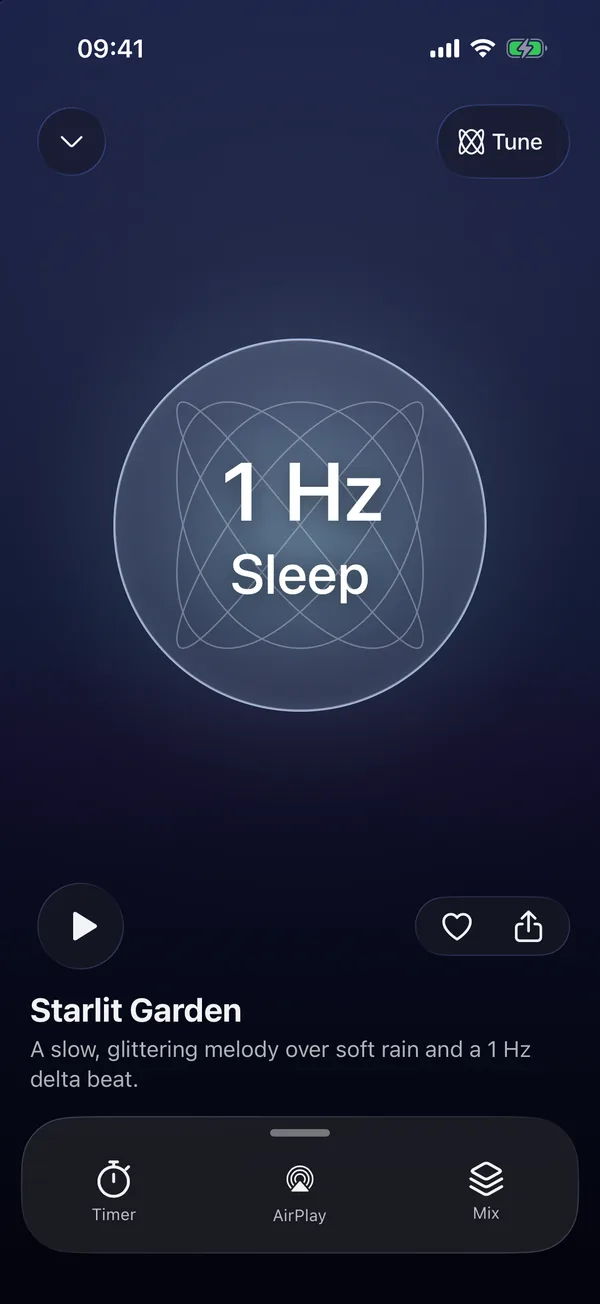
| Falling asleep | Delta, 1–3 Hz | Starlit Garden, 1 Hz; Night Halo, 2 Hz |
| Waking in the night | Delta, 0.5–1 Hz | Dreamy Descent, 0.5 Hz; Stay Asleep Garden |
| Noisy bedroom | Noise + delta | Brown Noise Deep Sleep, Rain Drift |
The carrier, meaning the pitch of the tones, matters for comfort. Low carriers between about 100 and 200 Hz sound warm and soft, which suits bedtime better than bright, high tones.
How to listen in bed
- Choose comfortable headphones. Soft sleep earbuds or a sleep headband work best. If you share a bed or sleep on your side, use an isochronic tone or noise through a speaker instead.
- Turn it down. Set the volume just loud enough to hear. The World Health Organization advises keeping personal listening at safe levels; at night, quieter is always better.
- Set a timer with a fade. Thirty to sixty minutes is enough to fall asleep. A gentle fade avoids being woken by the sound stopping.
- Keep the screen dark. Start the sound, then put the phone face down.
- Repeat for a few nights. One night says little. Use the same sound at the same time for a week, then judge.
Beats, noise or both?
Steady noise and binaural beats do different jobs. Noise masks the sudden sounds that wake you: traffic, a neighbour, a snoring partner. A slow beat under a melody gives a restless mind something gentle to follow. If both apply to you, combine them: a delta beat over brown noise or rain covers the room and slows you down at the same time.
When to see a doctor
Sounds can make bedtime calmer; they do not treat sleep disorders. If you have trouble sleeping three or more nights a week for over three months, snore loudly or stop breathing in your sleep, or feel exhausted during the day, talk to a doctor. Short nights also add up: one study found that sleep loss raises the stress hormone cortisol the next evening.
Frequently asked questions
What Hz is best for sleep?
Delta beats, from 0.5 to 4 Hz, are the band linked to deep sleep and the usual choice. Many people start with theta (around 6 Hz) for a few minutes while unwinding, then switch to delta, such as 1 to 3 Hz.
Is it OK to listen to binaural beats all night?
There is no evidence that it is harmful at a low volume, but there is also no evidence that all night is better. A timer of 30 to 60 minutes that fades out is a sensible default, and it saves your ears from hours of sound.
Can I sleep with headphones on?
Use soft sleep earbuds or a headband with flat speakers, not stiff over-ear headphones. Keep the volume low. If you sleep on your side or share a bed, a speaker with an isochronic tone or plain noise is an easy alternative.
Binaural beats or white noise for sleep?
If outside noise wakes you, steady noise is the stronger choice: it masks sudden sounds. If a busy mind keeps you up, a slow beat under a soft melody may help you unwind. Many people combine both, for example a delta beat over brown noise or rain.
How long before binaural beats work for sleep?
Studies usually measure a single night, and individual results vary. Give a sound a few nights in a row at the same time before judging it, and keep the rest of your routine steady.
Sources
- Jirakittayakorn N, Wongsawat Y. A novel insight of effects of a 3-Hz binaural beat on sleep stages during sleep. Frontiers in Human Neuroscience, 2018
- Messineo L, et al. Broadband sound administration improves sleep onset latency in healthy subjects in a model of transient insomnia. Frontiers in Neurology, 2017
- Papalambros NA, et al. Acoustic enhancement of sleep slow oscillations and concomitant memory improvement in older adults. Frontiers in Human Neuroscience, 2017
- Garcia-Argibay M, Santed MA, Reales JM. Efficacy of binaural auditory beats in cognition, anxiety, and pain perception: a meta-analysis. Psychological Research, 2019
- Leproult R, et al. Sleep loss results in an elevation of cortisol levels the next evening. Sleep, 1997
- World Health Organization. Deafness and hearing loss (safe listening)
This guide is for general information about sound and relaxation. It is not medical advice. MentalWave is a wellness app, not a medical device. If sleep problems, headaches or ringing in the ears last or worry you, see a doctor.