What are binaural beats? How they work and what the research says
Two tones, one in each ear, and a pulse that exists only in your head. Here is how binaural beats work, which frequency does what, and how strong the evidence really is.
How a binaural beat works
Play a pure tone of 200 Hz in your left ear and 210 Hz in your right. Neither tone pulses. Yet you hear a soft “wah-wah-wah” ten times a second. That 10 Hz pulse is the binaural beat, and it is not in either sound: your brain builds it while combining what the two ears hear.
The effect was described in 1839 by the physicist Heinrich Wilhelm Dove and made popular in 1973 by the biophysicist Gerald Oster, who suggested it could be a tool for research on hearing and the brain.
Two numbers describe every binaural beat:
- The carrier: the pitch of the tones you hear, for example 200 Hz. Lower carriers sound warmer and are easier on the ear. Beats are clearest with carriers under about 1000 Hz.
- The beat: the difference between the two tones, for example 10 Hz. This is the speed of the pulse.
The five frequency bands
The beat is usually chosen to fall in one of the bands used to describe brainwaves, measured with EEG. The idea behind binaural beats, called entrainment, is that a steady pulse may nudge brain activity toward the same rhythm. That idea is still debated, but the bands give a practical map:
| Band | Beat | Usually associated with |
|---|---|---|
| Delta | 0.5–4 Hz | Deep, slow-wave sleep |
| Theta | 4–8 Hz | Drowsiness, daydreaming, meditation |
| Alpha | 8–12 Hz | Relaxed wakefulness |
| Beta | 12–30 Hz | Active thinking, focus |
| Gamma | 30–40 Hz | Alert attention |
Do binaural beats work?
The honest answer: there is real evidence of small effects, and plenty of open questions.
- Anxiety. A 2019 meta-analysis of 22 studies found an overall medium effect of binaural beats across memory, attention, anxiety and pain perception, including lower anxiety. Earlier, a randomised trial in 2005 found that patients who listened to binaural beats before surgery felt less anxious.
- Attention. The same meta-analysis found effects on attention and memory tasks, stronger when people listened before the task. A 2015 study found that 40 Hz beats helped some people notice things that usually slip past their attention, and a 1998 study linked beta beats to better vigilance than theta beats.
- Sleep. In a small lab study, a 3 Hz beat played during sleep lengthened deep sleep. You can read more in our guide to binaural beats for sleep.
The limits matter too. Many studies have fewer than 50 participants, they use different frequencies and session lengths, and some find no effect at all. Effects are modest and vary from one person to the next. That is why, in MentalWave, we say a sound may help and never that it treats anything.
Binaural beats vs isochronic tones
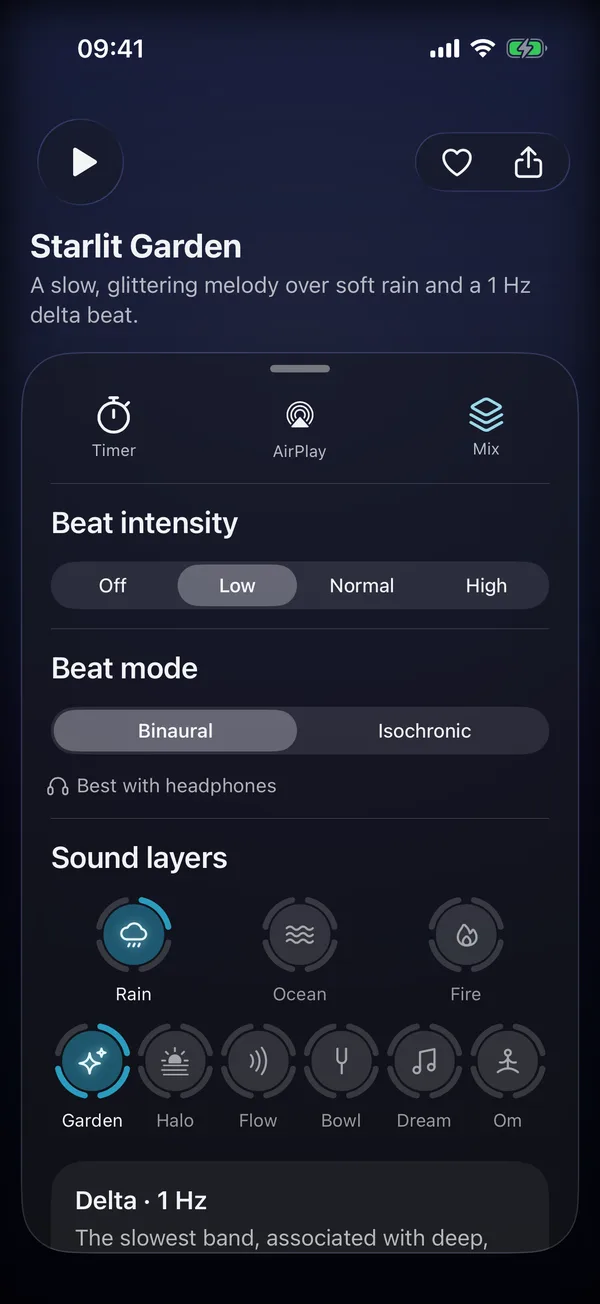
An isochronic tone is a single tone that switches on and off at a steady rate. Because the pulse is in the sound itself, it works through a speaker, with no headphones. It is also more noticeable, which some people like for focus and others find too insistent for sleep.
How to listen
- Use headphones for binaural beats. Over-ear headphones or soft sleep earbuds both work.
- Keep the volume low. The beat works at a quiet, comfortable level. Loud is not better.
- Pick the band for your goal: delta for sleep, theta or alpha to unwind, beta or 40 Hz gamma for focus.
- Give it 15 to 30 minutes, and notice how you feel rather than forcing it.
- Try a melodic mix. A bare beat can sound clinical. Hiding it under soft music or rain makes it easier to listen to for long sessions.
If you have epilepsy, are pregnant, or have a heart condition, ask your doctor before using rhythmic audio. Never listen while driving.
Frequently asked questions
Do binaural beats need headphones?
Yes. The effect depends on each ear receiving its own tone, which only headphones or earbuds guarantee. Through speakers, the two tones mix in the air and you hear an ordinary acoustic beat instead. Isochronic tones are the speaker-friendly alternative.
How long should I listen to binaural beats?
Most studies used sessions of 10 to 30 minutes. For sleep, people often listen while falling asleep with a timer that fades the sound out. There is no proven ideal length.
Are binaural beats safe?
For most people, listening at a comfortable, low volume is considered safe. Keep the volume low, especially through earbuds at night. If you have epilepsy or a seizure disorder, ask your doctor before using rhythmic audio, and stop if you feel unwell.
What is the difference between binaural beats and isochronic tones?
A binaural beat is created inside your brain from two tones, one per ear. An isochronic tone is a single tone switched on and off at a steady rate, so the pulse is in the sound itself and works through speakers.
Which binaural beat frequency is best?
It depends on the goal: delta (0.5 to 4 Hz) is used for sleep, theta (4 to 8 Hz) for deep relaxation, alpha (8 to 12 Hz) for calm wakefulness, beta (12 to 30 Hz) for focus and gamma (around 40 Hz) for attention.
Sources
- Oster G. Auditory beats in the brain. Scientific American, 1973
- Garcia-Argibay M, Santed MA, Reales JM. Efficacy of binaural auditory beats in cognition, anxiety, and pain perception: a meta-analysis. Psychological Research, 2019
- Padmanabhan R, Hildreth AJ, Laws D. Binaural beat audio and pre-operative anxiety. Anaesthesia, 2005
- Jirakittayakorn N, Wongsawat Y. Effects of a 3-Hz binaural beat on sleep stages. Frontiers in Human Neuroscience, 2018
- Reedijk SA, Bolders A, Colzato LS, Hommel B. Eliminating the attentional blink through binaural beats. Frontiers in Psychiatry, 2015
- Lane JD, Kasian SJ, Owens JE, Marsh GR. Binaural auditory beats affect vigilance performance and mood. Physiology & Behavior, 1998
This guide is for general information about sound and relaxation. It is not medical advice. MentalWave is a wellness app, not a medical device. If sleep problems, headaches or ringing in the ears last or worry you, see a doctor.