Solfeggio frequencies explained: 396, 528, 852 Hz and 432 Hz, honestly
The 528 Hz “love frequency”, 963 Hz, 432 Hz tuning: where these numbers come from, what the few studies found, and how to enjoy them without the hype.
Where Solfeggio frequencies come from
The word solfeggio comes from the sol-fa syllables singers still use: do, re, mi. They were taken from the first syllables of a medieval hymn to Saint John, Ut queant laxis, used by the monk Guido of Arezzo around the year 1000 to teach singing.
The frequencies are a modern addition. In the 1990s, Joseph Puleo said he had found a sequence of numbers hidden in the Bible; the writer Leonard Horowitz then made them famous as “healing codes”. Medieval singers had no way to measure hertz, so the list is not historical, even if the name is.
The nine tones and what is said about them
| Frequency | Traditional meaning given to it |
|---|---|
| 174 Hz | Grounding, easing tension |
| 285 Hz | Restoring, renewal |
| 396 Hz | Releasing fear and guilt |
| 417 Hz | Undoing situations, change |
| 528 Hz | “Love frequency”, transformation |
| 639 Hz | Connection, relationships |
| 741 Hz | Clarity, expression |
| 852 Hz | Intuition, returning to order |
| 963 Hz | Oneness, awakening |
These meanings belong to a spiritual tradition. They are not medical effects, and we describe them in MentalWave in exactly that way.
What the research says
Very little research has looked at Solfeggio tones directly:
- 528 Hz. A small Japanese study in 2018 compared music at 528 Hz and 440 Hz and reported lower stress markers after the 528 Hz version. The sample was tiny, so it is a hint, not proof. The popular claim that 528 Hz repairs DNA has no scientific support.
- 432 Hz. In a 2019 double-blind pilot study, 33 volunteers listened to the same soundtracks tuned to 432 Hz or 440 Hz. The 432 Hz version went with a lower heart rate and slightly lower blood pressure, though the blood-pressure change was not significant. Again: small and early.
The broader evidence points somewhere more modest and more useful: calm, steady sound helps many people relax, and binaural beats show small effects on anxiety in pooled studies. A pleasant tone you enjoy is likely to help you unwind whatever its exact number.
How to enjoy them without the hype
- Pick by ear, not by promise. Lower tones like 174 and 396 Hz feel warm; 852 and 963 Hz are bright and airy. Choose what feels calming to you.
- Pair a tone with a slow beat. In MentalWave, most Solfeggio sounds sit on a theta or alpha beat, for example 528 Garden with a 6 Hz beat, so they work like any relaxation mix.
- Keep it soft. High tones get tiring fast. A low volume and a melody around the tone make long sessions comfortable.
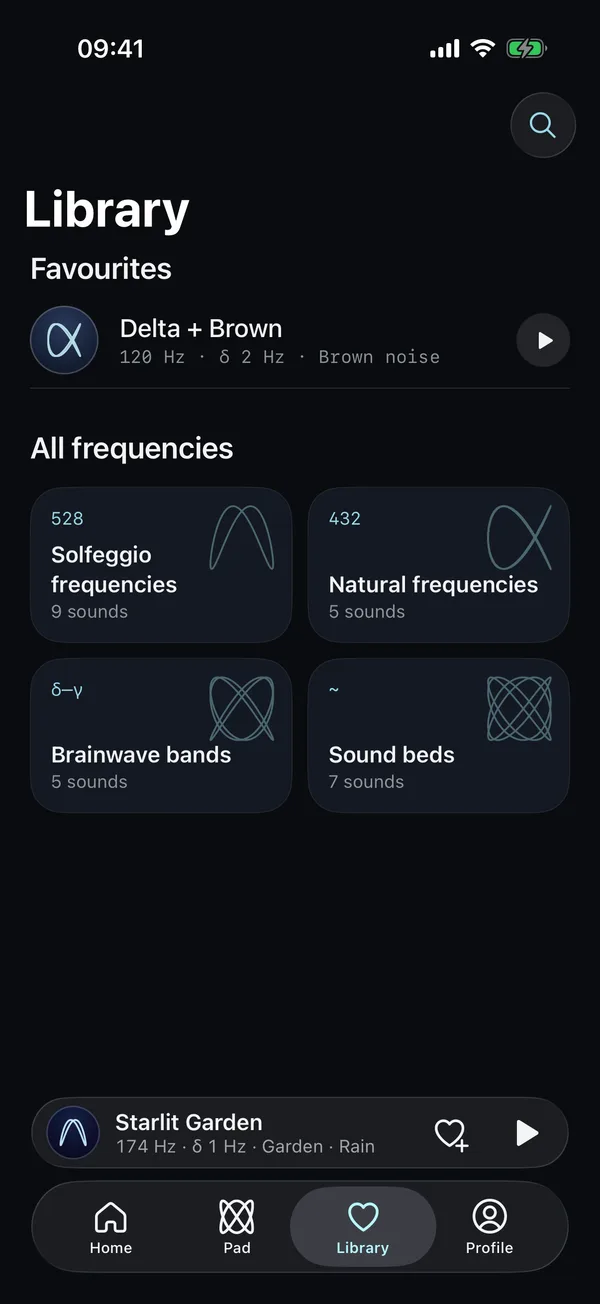
432 Hz vs 440 Hz in one minute
Most music today is tuned so that the note A above middle C is 440 Hz. Tuning it to 432 Hz lowers every note slightly, by about a third of a semitone. Some listeners describe it as warmer. It is a matter of taste: if it relaxes you, use it.
Frequently asked questions
What is 528 Hz good for?
528 Hz is often called the “love frequency” and is claimed to repair DNA. There is no scientific evidence for DNA repair. A small 2018 study reported lower stress markers after listening to music at 528 Hz, but it was too small to draw conclusions. Many people simply find it a pleasant, calming tone.
Is 432 Hz better than 440 Hz?
440 Hz is the standard tuning for the note A. In a 2019 pilot study of 33 people, music tuned to 432 Hz went with a slightly lower heart rate than the same music at 440 Hz. It was a small, early study. If you prefer the softer sound of 432 Hz, enjoy it, but the difference is subtle.
Are Solfeggio frequencies scientifically proven?
No. The specific healing claims made for each Solfeggio frequency have not been tested in rigorous studies. What research does support is more general: calm music and steady sound can help people relax.
Where do Solfeggio frequencies come from?
The name refers to the medieval sol-fa syllables (ut, re, mi, fa, sol, la) from an 11th-century hymn. The modern list of frequencies was put forward in the 1990s by Joseph Puleo and made popular by Leonard Horowitz. It is not part of the medieval tradition itself.
Sources
- Akimoto K, Hu A, Yamaguchi T, Kobayashi H. Effect of 528 Hz Music on the Endocrine System and Autonomic Nervous System. Health, 2018
- Calamassi D, Pomponi GP. Music Tuned to 440 Hz Versus 432 Hz and the Health Effects: A Double-blind Cross-over Pilot Study. Explore, 2019
- Garcia-Argibay M, Santed MA, Reales JM. Efficacy of binaural auditory beats in cognition, anxiety, and pain perception: a meta-analysis. Psychological Research, 2019
This guide is for general information about sound and relaxation. It is not medical advice. MentalWave is a wellness app, not a medical device. If sleep problems, headaches or ringing in the ears last or worry you, see a doctor.