Sounds for tinnitus: how sound enrichment helps, and which noise to try
Silence makes ringing ears louder. Here is how background sound can make tinnitus easier to live with, which noise suits which ringing, and what the evidence says.
Why silence makes tinnitus louder
Tinnitus is a sound, often a ringing, hiss or hum, that you hear without any outside source. In a busy room it fades into the background. In a quiet bedroom, with nothing else to listen to, the brain turns its attention to it, and it seems to grow louder. That is why many people notice their tinnitus most at bedtime.
Sound enrichment works on that contrast. A gentle, steady sound in the background gives the brain something else to hear, so the tinnitus stands out less.
What the evidence says
- Widely recommended. The American Tinnitus Association and the US National Institute on Deafness and Other Communication Disorders both describe sound therapy as a common part of tinnitus management, often alongside counselling.
- Limited proof on its own. A Cochrane review found too few good-quality trials to show that sound therapy alone reduces tinnitus. That does not mean it does not help; it means it has not been tested well enough.
- Better sleep. Steady broadband sound helped healthy people fall asleep faster in a 2017 trial. For people whose tinnitus keeps them awake, that is often the main benefit.
So the honest goal is relief: a calmer evening and an easier time falling asleep, not a cure.
Which sound to try
| Your tinnitus | Try first | Why |
|---|---|---|
| High-pitched ringing or whistling | Pink noise, rain | Softer than white noise, covers the high range gently |
| Low hum or buzz | Brown noise, distant waves | Deep, warm sound in the low range |
| Hiss | Ocean, rain, a soft melody | A changing natural sound is less tiring than a matching hiss |
| Varies, or keeps you awake | A melody over noise | Gives your attention something pleasant to follow |
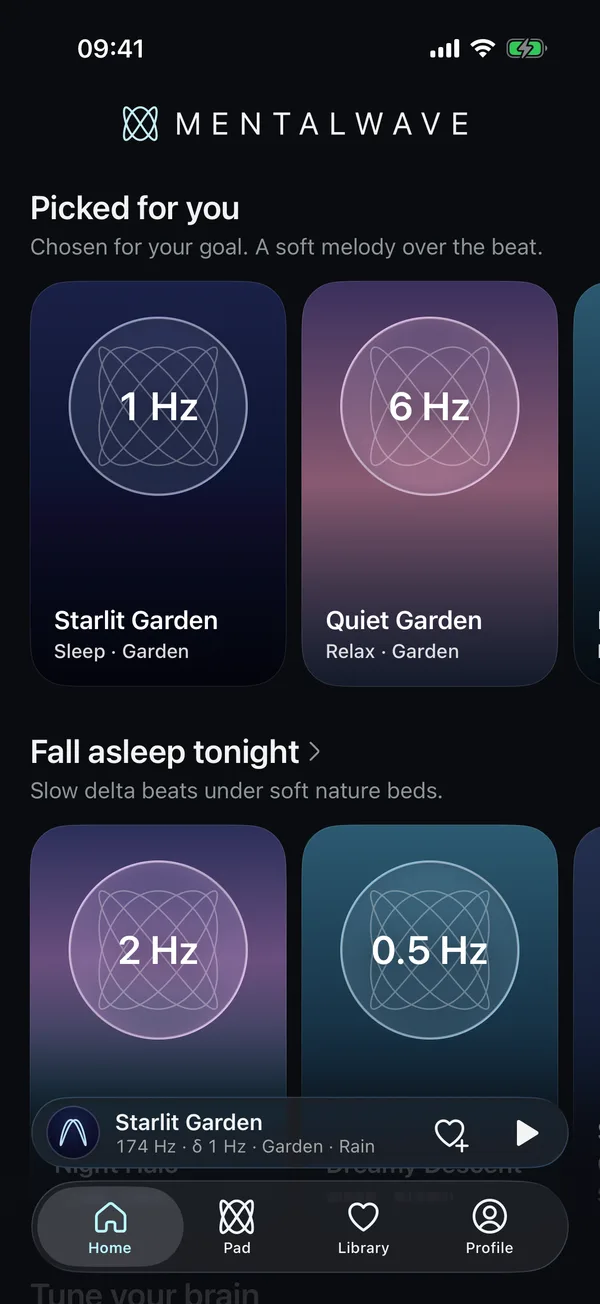
In MentalWave, the Pure noise section has brown, pink and white noise, plus two mixes made for ringing ears: Soft Cover, pink noise under a gentle melody for high-pitched ringing, and Warm Cover, brown noise with a warm drone for low ringing.
How to set the volume
- Start in a quiet room and play the sound very low.
- Raise it slowly until the tinnitus is a little less noticeable, but still just audible. This is often called the mixing point.
- Stay below that level. If the sound is louder than your tinnitus, or uncomfortable, turn it down.
- At night, use a speaker or a pillow speaker when you can, rather than earbuds, and a timer.
When to see a doctor
See a doctor or an audiologist if your tinnitus is new, is in one ear only, beats in time with your pulse, comes with hearing loss or dizziness, or affects your sleep or mood. Sudden hearing loss is an emergency. MentalWave is a relaxation app; it can be part of your evening routine, but not a replacement for a hearing check.
Frequently asked questions
What is the best noise for tinnitus?
There is no single best one. Many people with high-pitched ringing find pink noise or rain soothing; people with a low hum often prefer brown noise. Try a few for several minutes each and keep the one that feels most comfortable.
Should the sound be louder than my tinnitus?
Usually not. Hearing charities suggest setting the sound just below your tinnitus, so that you can still hear both. The goal is to make the ringing less noticeable, not to drown it out.
Can sound therapy cure tinnitus?
No. A Cochrane review found too little good evidence to say sound therapy alone reduces tinnitus, though it is widely used and many people find it helps them cope and sleep. Talk to a doctor or audiologist about your tinnitus.
Can binaural beats help tinnitus?
There is little research on binaural beats for tinnitus specifically. A soft beat under steady noise can be relaxing, and stress often makes tinnitus feel worse, but noise and nature sounds are the better-established choice.
Sources
- Hobson J, Chisholm E, El Refaie A. Sound therapy (masking) in the management of tinnitus in adults. Cochrane Database of Systematic Reviews, 2012
- American Tinnitus Association. Sound therapy
- National Institute on Deafness and Other Communication Disorders (NIDCD). Tinnitus
- Messineo L, et al. Broadband sound administration improves sleep onset latency in healthy subjects. Frontiers in Neurology, 2017
- World Health Organization. Deafness and hearing loss (safe listening)
This guide is for general information about sound and relaxation. It is not medical advice. MentalWave is a wellness app, not a medical device. If sleep problems, headaches or ringing in the ears last or worry you, see a doctor.