40 Hz binaural beats for focus: what the research says
40 Hz is the most talked-about beat for concentration. Here is what the small attention studies actually found, why the headlines about 40 Hz come from mice, and how to try it sensibly.
What 40 Hz means
A binaural beat is built from two tones, one in each ear. Play 432 Hz on the left and 472 Hz on the right, and your brain perceives a pulse at the difference between them: 40 times a second. If you are new to the idea, start with how binaural beats work.
Forty hertz sits in the gamma band, the fastest of the brainwave bands measured with EEG. Gamma activity is linked to alert, concentrated states: holding information in mind, noticing details, binding what you see and hear into one picture. The hope behind 40 Hz beats is that a fast, steady pulse nudges the brain toward that kind of attention.
Compared with the other bands used for focus, 40 Hz is the quickest pulse:
| Band | Beat | Usually used for |
|---|---|---|
| Alpha | 8–12 Hz | Relaxed attention, reading, light work |
| Beta | 12–30 Hz | Staying on task, steady alertness |
| Gamma | around 40 Hz | Short bursts of intense concentration |
What the attention studies found
Most of the research on 40 Hz beats and focus comes from a handful of lab studies with healthy adults. Their findings are interesting, and they are also small.
- Catching what slips past. In a 2015 study, people did an “attentional blink” task: spotting two targets in a fast stream of images, where the second one is often missed. High-frequency binaural beats eliminated that blink, but only in people with a low natural eye-blink rate, a rough marker of brain dopamine. The effect depended on the person.
- A narrower spotlight. In a 2017 study, adults listened to 40 Hz beats or a plain 340 Hz tone for 3 minutes before and during a task that compares seeing the big picture with seeing the details. After the 40 Hz beats, their attention was more focused, which the authors describe as a smaller “spotlight of attention”. The beats did not help people ignore irrelevant information.
- Faster training gains. In a 2020 study, people practised the attentional blink task over three days with 40 Hz or 16 Hz beats. Brain recordings (MEG) showed a strong 40 Hz response during the 40 Hz beats. Performance did not jump within a session, but 40 Hz beats during training were linked to larger gains the next day, after a night’s sleep.
- Beta for vigilance. An older 1998 study with 29 people found that beta beats (16 and 24 Hz) went with more correct detections, fewer false alarms and better mood during a 30-minute vigilance task than slow beats did. That study did not test 40 Hz, but it is a reminder that beta is also a reasonable focus choice.
A 2019 meta-analysis of 22 studies found an overall medium effect of binaural beats on memory, attention, anxiety and pain. It also found that listening before a task, or before and during it, worked better than listening only during the task, and that longer exposure helped.
What we do not know
The idea that beats “train” your brainwaves is still unproven. A 2023 systematic review looked at fourteen EEG studies: five fit the entrainment idea, eight did not, and one was mixed, with very different methods from study to study. A 2017 study that played beats from theta to gamma for 3 minutes found no change in the matching EEG bands, and no change in heart rate or skin conductance.
So the honest summary: 40 Hz beats are linked to small changes in attention in some studies and some people, and we do not yet know why, or who benefits most. They are worth trying if you are curious. They are not a guaranteed productivity boost.
About the 40 Hz memory headlines
Many searches for 40 Hz come from news about Alzheimer’s research. In that work, researchers exposed mouse models of the disease to flickering 40 Hz light or 40 Hz tones. In a 2019 study, seven days of 40 Hz tones were linked to better memory and less amyloid, a protein linked to Alzheimer’s disease, in mouse models.
That is animal research with carefully controlled stimulation. It does not show that listening to 40 Hz audio protects memory in people, and it is not what a focus app does. If you are worried about your memory, or someone else’s, talk to a doctor.
How to try 40 Hz for focus
- Pick the right format. Binaural beats need headphones. If you work with a speaker or one earbud, use a 40 Hz isochronic tone, where the pulse is in the sound itself.
- Start before the task. Press play a few minutes before you begin, then keep it running, as in the studies that found the clearest effects.
- Work in blocks. Twenty to forty-five minutes, then a short break. A timer that fades the sound out marks the end of a block without a jolt.
- Keep it quiet. A low, comfortable volume is enough. Louder does not mean sharper focus.
- Hide the beat if it grates. A bare 40 Hz pulse can feel buzzy. Under soft music or steady noise it becomes background.
- Compare with beta. Try a week with 40 Hz and a week with a 15 to 18 Hz beta beat. Keep the one that feels easier to work with.
In MentalWave, the Focus section has both: Flow 40 puts a 40 Hz beat under the flow melody, and Deep Work 40 is a 40 Hz isochronic pulse over brown noise that works without headphones. Flow State, a 15 Hz beta mix, is the free place to start. On the Pad you can also tune a gamma beat yourself, anywhere from 30 to 40 Hz, on a carrier you find comfortable.
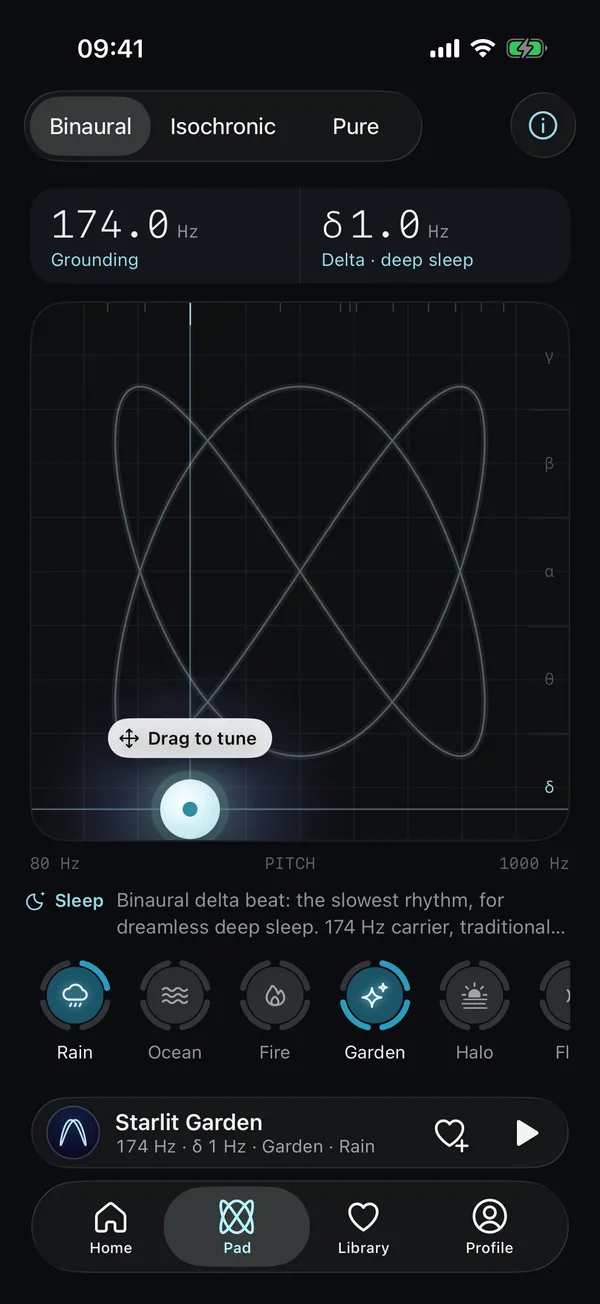
For more ways to set up a work session with sound, see our sound library and the studies behind each band on the science page.
Who should be careful
Rhythmic audio, especially fast pulses, is not for everyone. If you have epilepsy or a seizure disorder, ask your doctor before using it. Stop if you feel dizzy, anxious or unwell, never listen while driving, and keep the volume low: your ears matter more than any beat.
Frequently asked questions
What do 40 Hz binaural beats do?
They play a tone in each ear 40 Hz apart, so you perceive a fast 40 Hz pulse. In small studies, 40 Hz beats were linked to a narrower spotlight of attention and, in some people, better detection of fast-moving targets. They are used for concentration, not for sleep.
Is 40 Hz or beta better for focus?
There is no head-to-head answer. Beta beats (around 14 to 30 Hz) were linked to better vigilance than slow beats in a 1998 study, and 40 Hz beats were linked to sharper attention in later studies. Many people find beta easier to listen to for long sessions and use 40 Hz for shorter, intense tasks. Try both and keep the one that feels better.
Can 40 Hz sound help with Alzheimer's disease?
The research behind those headlines was done mostly in mice, using carefully timed 40 Hz light and sound. It is early-stage science, not evidence that listening to 40 Hz audio at home protects memory or treats any disease. Anyone worried about memory should talk to a doctor.
Do I need headphones for 40 Hz?
For binaural beats, yes: each ear must hear its own tone. A 40 Hz isochronic tone, a tone switched on and off 40 times a second, carries the pulse in the sound itself and works through a speaker.
How long should I listen to 40 Hz beats?
In the attention studies, people listened for a few minutes before and during a task. A 2019 meta-analysis found that listening before a task worked better than only during it, and that longer exposure helped. A 20 to 45 minute work block is a reasonable place to start.
Sources
- Reedijk SA, Bolders A, Colzato LS, Hommel B. Eliminating the attentional blink through binaural beats: a case for tailored cognitive enhancement. Frontiers in Psychiatry, 2015
- Colzato LS, Barone H, Sellaro R, Hommel B. More attentional focusing through binaural beats: evidence from the global-local task. Psychological Research, 2017
- Ross B, Lopez MD. 40-Hz binaural beats enhance training to mitigate the attentional blink. Scientific Reports, 2020
- Lane JD, Kasian SJ, Owens JE, Marsh GR. Binaural auditory beats affect vigilance performance and mood. Physiology & Behavior, 1998
- Garcia-Argibay M, Santed MA, Reales JM. Efficacy of binaural auditory beats in cognition, anxiety, and pain perception: a meta-analysis. Psychological Research, 2019
- Ingendoh RM, Posny ES, Heine A. Binaural beats to entrain the brain? A systematic review of the effects of binaural beat stimulation on brain oscillatory activity. PLOS ONE, 2023
- López-Caballero F, Escera C. Binaural beat: a failure to enhance EEG power and emotional arousal. Frontiers in Human Neuroscience, 2017
- Martorell AJ, et al. Multi-sensory gamma stimulation ameliorates Alzheimer's-associated pathology and improves cognition. Cell, 2019
This guide is for general information about sound and relaxation. It is not medical advice. MentalWave is a wellness app, not a medical device. If sleep problems, headaches or ringing in the ears last or worry you, see a doctor.